
Emergency Tooth Extraction: Know When to Act vs. Wait

Persistent tooth pain creates a difficult decision: seek immediate dental care or wait for a regular appointment. At Wilmington Family Dental, Dr. S. Zak Hallock frequently sees patients who have managed tooth pain for weeks or months before determining whether their situation requires urgent attention.
Most tooth pain can be managed until a scheduled appointment. However, specific symptoms indicate a dental emergency that requires immediate professional evaluation. Facial swelling, severe pain unresponsive to over-the-counter medication, or signs of spreading infection require prompt treatment to prevent complications and more extensive procedures.
This clinical guide helps you identify emergency situations and understand when tooth extraction may be necessary for your oral health and overall well-being.
Continue reading to learn the specific warning signs that require immediate dental attention.

Knowing which situation you're actually in starts with being honest about what your body is telling you. Some tooth pain is uncomfortable but stable. Other tooth pain is your body sending up a flare. The difference matters, and it's not always obvious when you're in the middle of it.
Here's the clearest way to think about it. When over-the-counter pain medication isn't touching it, that's a signal worth taking seriously. A tooth that aches and then settles down is a different animal than one that keeps you awake at 2 a.m. no matter what you take. Uncontrolled pain that won't respond to ibuprofen or acetaminophen usually means the problem has progressed beyond the point where your body can manage it on its own.
Facial swelling changes the equation entirely. Any swelling near the jaw, neck, or eye socket is a genuine emergency. Dental infections don't always stay put, and when they spread into surrounding tissue, they can become dangerous quickly. A fever alongside tooth pain tells the same story. Your immune system is fighting something, and that something needs professional attention, not another day of waiting.
Visible trauma also moves you out of the "uncomfortable but stable" category. A tooth cracked below the gumline, a tooth knocked loose from significant impact, or anything that's changed the way your bite feels after an injury all warrant same-day care.
Waiting on these specific situations doesn't save money. It typically means a more complex procedure later, and sometimes it means a longer recovery. Getting seen quickly is almost always the more affordable path when these red flags are present.
Sometimes the most expensive decision you can make is trying to save a tooth that simply cannot be saved. It's a harder conversation to have, but it's an honest one, and it matters for your wallet as much as it does for your long-term oral health.
There are real situations where a root canal and crown stop making financial sense. A tooth that has lost too much structure to hold a crown reliably is looking at a restoration that may fail within a few years anyway. Severe bone loss around a tooth creates a similar problem. The foundation just isn't there to support the work. And when infection has spread beyond what a root canal can fully address, pushing forward with a save attempt can actually delay healing and lead to more treatment down the road.
The cost comparison matters too. In some cases, the combined expense of a root canal, post, and crown comes close to or exceeds what you'd spend on an extraction plus a future implant. An implant is a longer-term investment, but it's a stable, lasting one. Running those numbers before committing to a complex save is completely reasonable, and any good dental team will help you do exactly that.
Losing a tooth carries real emotional weight. But extraction isn't a failure. It's sometimes the clearest path to getting out of pain, stopping the spread of infection, and building toward a healthier mouth. For anyone weighing their options, our tooth extraction page walks through what the process actually looks like and what comes next.
When a tooth is screaming at you at 11pm, the instinct is to head straight to the emergency room. It makes sense if you're in pain, something feels wrong, and the ER is open. But something that frustrates most people is realizing that the ER can give you antibiotics and something for the pain, and that's genuinely helpful when infection is involved, but what they cannot do is fix the tooth. You'll leave with a prescription and instructions to follow up with a dentist, which means you're still going to need that appointment.
So when does the ER actually make sense? Swelling that's moving toward your throat, making it hard to swallow, or affecting your breathing warrants an immediate visit. A high fever alongside tooth pain can signal that an infection has spread beyond the tooth itself, and that warrants urgent medical attention. Those situations are serious and the ER is the right call.
Everything else, including severe pain, a broken tooth, a lost crown, or swelling that's uncomfortable but not affecting your airway, is exactly what an emergency dental appointment is designed to handle. A dentist can actually solve the problem, not just quiet it down temporarily. For patients who need a practice that takes those calls seriously and gets them in quickly, Wilmington Family Dental is built around that kind of care.
Dental infections don't wait for our convenience. A localized abscess, caught early, is very often treatable with a straightforward procedure. But left alone, that same infection spreads, moves into surrounding tissue, into the bone, sometimes into neighboring teeth that were perfectly healthy before. Advanced bone loss cannot be reversed, and a tooth that could've been saved at week one can become non-restorable by week four.
This matters especially for anyone navigating a coverage gap or a waiting period. It's completely understandable to feel frustrated when your plan won't cover certain procedures right away. But keep in mind that the cost of letting an infection progress almost always outpaces the cost of treating it early, with or without insurance. A filling is less expensive than a root canal. A root canal is less expensive than an extraction and an implant. Every step up that ladder is one that could often have been avoided.
For anyone weighing their options or unsure what their situation actually requires, the dental resources at Wilmington Family Dental are a good place to start, and a quick call to the office can tell you a lot more than waiting ever will.
Walking into a dental office in pain, not knowing what's about to happen, is genuinely stressful. So let's just walk through it.
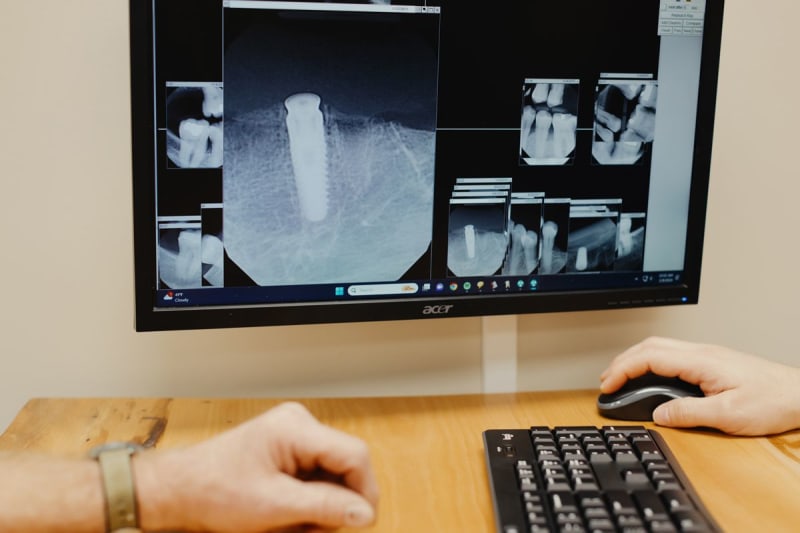
When you come in, the first thing we do is take a look and get an X-ray. That image tells us a lot, and honestly, extraction isn't always the only answer even in an emergency. A path to saving the tooth may still exist, and we'll talk through it with you.

But if extraction is the right call, we'll explain why and make sure you're comfortable with the plan before anything happens. The procedure itself starts with local anesthesia, which means the area goes numb before we do anything else. Most extractions are straightforward and take far less time than people expect. Same-day relief is the goal, and we take that seriously.
Aftercare instructions go home with you, and they're simple to follow. As for what comes next, whether that's a tooth replacement option like an implant or bridge, that conversation doesn't have to happen today. It's a separate decision, made when the immediate problem is behind you and you have the space to think clearly.
If you're experiencing dental pain and unsure whether it requires immediate attention, don't wait for it to worsen. Dr. Hallock and the team at Wilmington Family Dental are equipped to handle emergency situations and provide same-day relief when needed.
Call (937) 867-7647 to speak with our team about your symptoms and schedule an appointment. We'll help you determine the best course of action and get you out of pain as quickly as possible.
Contact us for more information about our emergency dental services.
We look forward to meeting you.
Contact us today to schedule an appointment.